The Environmental Cost of the “Stock-First” Model
For decades, the fashion industry has operated on a “push” system—a gamble where brands predict what you’ll want to wear six months in advance, manufacture it by the thousands in overseas factories, and “push” it into stores. This Stock-First model is built on the dangerous assumption that more is better. In reality, this approach has created a systemic ecological crisis that the planet can no longer afford to subsidize.
The Ghost of Unsold Inventory
The most haunting aspect of traditional retail isn’t what people wear, but what they don’t. When trends shift or predictions fail, brands are left with mountains of “deadstock.” To protect “brand exclusivity” and avoid devaluing their image through heavy discounting, many global labels have historically resorted to incinerating unsold clothes or sending them straight to landfills.
In India, where we serve as both a global manufacturing hub and a massive consumer market, the impact is doubled. We see the literal weight of overproduction in overflowing textile clusters and degraded local ecosystems. When we produce garments that never find a home, we aren’t just wasting fabric; we are discarding the thousands of liters of water, the energy, and the human labor that went into creating them.
Breaking the Cycle of Fast Fashion
The Stock-First model thrives on the “Fast Fashion” cycle: low quality, high volume, and rapid turnover. This cycle necessitates the use of cheap, synthetic fibers and aggressive chemical dyes to keep costs down and margins high.
- Microplastic Pollution: Synthetic fabrics like virgin polyester, often used in mass-produced stock, shed microfibers into our water systems with every wash.
- Carbon Footprint: The logistics of moving massive amounts of inventory from global factories to warehouses, and finally to retail outlets, creates a carbon trail that spans the globe.
By moving away from this “produce more, sell less” mentality, we address the root cause of fashion’s waste problem. Sustainability isn’t just about using organic cotton; it’s about ensuring that not a single thread is wasted on a garment that doesn’t have a person waiting to wear it.
Print on Demand: The Lean Revolution
If the “Stock-First” model is a gamble, Print on Demand (POD) is a conversation. It shifts the power from the warehouse to the individual, ensuring that a garment only enters the physical world once it has a purpose and a person waiting for it. This “pull” system—where demand dictates production—is the leanest way to operate in the modern age.
What is POD?
At its core, POD is a tech-driven manufacturing process. Instead of printing 5,000 t-shirts and hoping they sell, we host digital designs in a virtual storefront. The moment you place an order, our facility receives the data, selects the raw garment, and prints the design specifically for you. It’s the difference between a buffet that wastes half its food and a farm-to-table meal prepared precisely to your order.
Efficiency Meets Creativity
The traditional model stifles creativity because it demands “safe” designs that appeal to the masses to minimize the risk of unsold stock. POD removes that financial anchor.
- Limitless Expression: Designers can experiment with niche aesthetics, intricate patterns, and bold cultural statements without the fear of a “failed” production run.
- Agility: We can respond to cultural moments in real-time. If a new trend emerges, it can be designed and available for purchase in hours, not months, all without creating a single scrap of physical waste until a customer engages.
Reduced Footprint: By eliminating the need for massive, energy-draining warehouses to store “just in case” inventory, POD significantly lowers the operational carbon footprint of the fashion supply chain.
Material Science: Why Our Fabrics Matter
In the traditional fashion world, the focus is often on the silhouette; in the future of sustainable fashion, the focus is on the fiber. At the intersection of technology and textiles, we ensure that every garment produced through Qikink isn’t just a canvas for art, but a masterpiece of responsible engineering.
Beyond the Surface: The DNA of Our Textiles
Our commitment to quality begins with the raw material. By leveraging TeeTalkies’ heritage—a legacy built on manufacturing and exporting premium plain apparel—we utilize high-grade fabrics that serve as the perfect foundation for digital printing. Whether it is the breathability of 100% premium combed cotton or specialized blends for our AOP (All-Over Print) and activewear collections, the goal is consistent: a soft hand-feel that survives the test of time and repeated washes.
The Gold Standard: OEKO-TEX Certified Printing
A garment is only as sustainable as the substances used to color it. This is where the science truly shines.
- OEKO-TEX Certified Inks: We exclusively use inks that meet the gold standard of textile safety. This certification ensures that our prints are free from harmful chemicals, making them safe for your skin and the environment.
- Water-Based Efficiency: Unlike traditional vat dyeing, which consumes and contaminates thousands of liters of water, our digital printing processes are significantly more efficient. Our water-based inks require minimal water, drastically reducing the chemical runoff that typically plagues textile hubs.
Precision Engineering: DTG, DTF, and Beyond
We don’t believe in a one-size-fits-all approach to printing. Depending on the design and fabric, we utilize India’s most advanced printing ecosystem to ensure durability and vibrancy:
- Direct to Garment (DTG): Ideal for intricate, multi-colored designs on cotton, providing a breathable finish where the ink bonds directly with the fibers.
- Direct to Film (DTF) & Sublimation: Used for high-durability transfers and vibrant all-over prints that never crack or peel.
- Embroidery & Screen Printing: Merging tech with tradition for premium, tactile branding.
Longevity as a Sustainability Metric
The most sustainable garment is the one you wear for years. By combining state-of-the-art hardware from industry leaders like Epson, Brother, and Mimaki with premium fabrics, we create products that resist fading and losing shape. When you choose POD, you aren’t just buying a trend; you are investing in a piece of material science designed to stay in your wardrobe and out of the landfill.
The Style Guide: Curating a Conscious Wardrobe
Adopting a sustainable mindset doesn’t mean sacrificing your aesthetic. In fact, the Print-on-Demand model encourages a more curated, personal approach to fashion. When every piece is made specifically for you, your wardrobe becomes a reflection of your values rather than a collection of impulsive “fast fashion” buys.
Here is how to style your POD pieces for maximum impact and minimal waste.
The Foundation: Building with Eco-Basics
Every great outfit starts with a high-quality foundation. Our premium cotton T-shirts and hoodies aren’t just “basics”—they are the canvas for your personal brand.
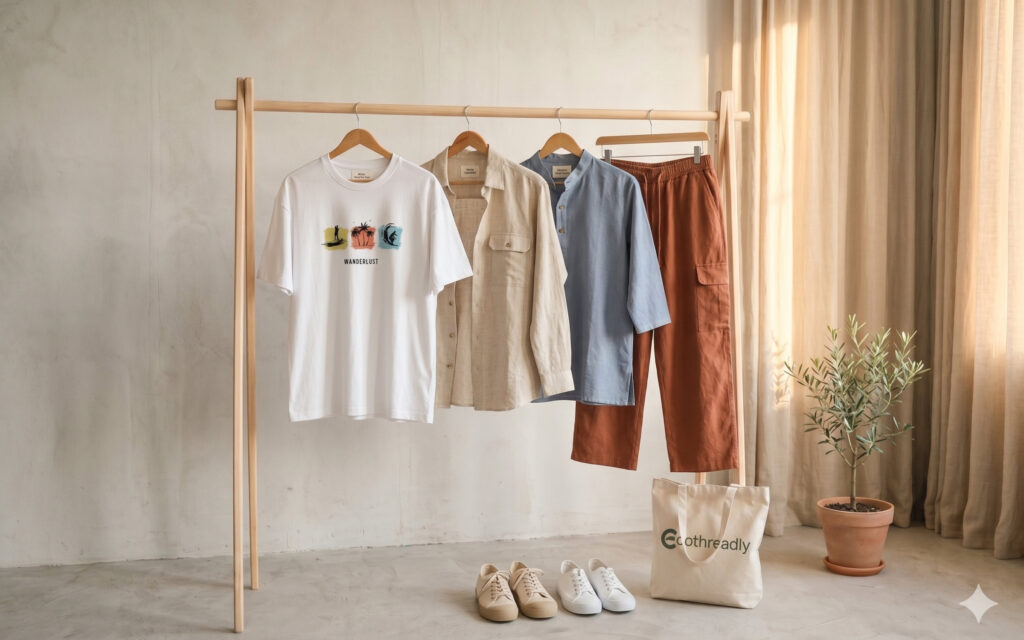
- The Minimalist Look: Pair a crisp, DTG-printed white tee with tailored trousers or high-waisted denim. The high stitch density of our fabrics ensures the garment hangs perfectly, giving a sophisticated silhouette that works in any setting.
- Layering for Longevity: Use our neutral-toned hoodies or sweatshirts under a structured blazer. This blends comfort with professionalism, proving that conscious clothing belongs in the boardroom.
Statement Sustainability
The beauty of POD is the ability to wear art that tells a story. Since there is no risk of overproduction, you can find niche, intricate designs that aren’t available in mass-market stores.
- The Hero Piece: Let one bold, graphic print take center stage. Pair a vibrant, OEKO-TEX certified print with muted, upcycled pieces you already own.
- Texture Play: Mix the smooth finish of a digital print with the tactile feel of embroidery. This adds depth to your outfit and highlights the craftsmanship behind the tech.
Day-to-Night Transitions
Versatility is the ultimate sustainability hack. If you can wear one garment in three different ways, you effectively reduce your need for three separate items.
- Day: Pair an oversized printed tee with sneakers and a tote bag for a functional, street-style vibe.
- Night: Tuck that same tee into a silk skirt or dark chinos, add a leather jacket, and swap the sneakers for boots.
- The 30-Wear Rule: Before purchasing, ask yourself: “Will I wear this at least 30 times?” Thanks to the durability of our Epson and Brother printing technology, the answer with our garments is a definitive “Yes.”
Curating Over Collecting
A conscious wardrobe isn’t built overnight. It’s about slow curation. By choosing POD, you are participating in a system where quality is prioritized over quantity. You aren’t just buying a shirt; you are supporting a movement that values design integrity and environmental respect.
Cultural Resonance: India’s Role in the Global Shift
Fashion has always been a mirror of Indian society—a blend of ancient heritage and rapid modernization. As the world moves toward more ethical consumption, India is uniquely positioned to lead this change, not just as a consumer base, but as a technological powerhouse.
Modernizing Indian Craftsmanship
India is home to a rich tapestry of traditional motifs, from Kalamkari to Ajrakh. Traditionally, mass-producing these designs led to a loss of soul or, worse, immense chemical waste from poor imitation.
- Digital Preservation: Through POD, we can digitize these intricate patterns and print them with precision. This allows for a “New Indian” aesthetic that honors traditional art while utilizing modern, eco-friendly water-based inks.
- Waste-Free Iteration: Designers can now experiment with fusion styles—mixing contemporary street-wear silhouettes with heritage prints—without the environmental guilt of bulk manufacturing.
Empowering Local Economies
The POD model thrives on decentralization. By moving away from the “Mega-Factory” concept and focusing on high-tech facilities like our 23,800 sq. ft. setup in Coimbatore, we are bringing manufacturing back to the heart of the community.
- Ethical Labor: Our production is primarily based in India, ensuring fair labor practices and living wages. In a “Stock-First” world, the pressure to cut costs often leads to unethical working conditions. In a “Demand-First” world, the focus shifts back to quality and the dignity of the person making the garment.
- Reducing the “Fashion Miles”: By producing locally and shipping directly to the Indian consumer, we drastically cut down on the carbon emissions associated with international freight and multi-layered logistics.
The Digital Renaissance
We are seeing a new wave of “Couchpreneurs”—Indian creators, YouTubers, and influencers—who are building global brands from their homes. POD provides the infrastructure for this digital renaissance, allowing anyone with a creative vision to start a brand with zero inventory risk. This democratization of fashion is inherently Indian: resourceful, tech-savvy, and deeply creative.
Conclusion: A Wardrobe with a Conscience
The shift from “Stock-First” to “Demand-First” isn’t just a technical upgrade; it’s a moral one. For too long, the fashion industry has asked us to choose between personal expression and planetary health. With the rise of Print on Demand, that compromise is finally becoming a relic of the past.
By choosing a model that produces only what is needed, we are collectively voting for a world with cleaner rivers, less landfill waste, and a more dignified life for the people who make our clothes. In India, where our heritage is rooted in the value of craftsmanship, returning to a “made-for-you” approach feels less like a new trend and more like a modern homecoming.
At Ecothreadly, we believe that style should never come at the cost of the future. By pairing the sophisticated logistics of Qikink with a commitment to material science and intentional design, we are proving that fashion can be both beautiful and blameless.
The future of Indian fashion isn’t sitting in a dusty warehouse waiting to be discounted. It’s being created right now—one unique, intentional, and sustainable piece at a time.
Join the “Zero-Waste” Movement
Your style has power. By choosing Print on Demand, you’re already making a statement against the environmental costs of overproduction. Now, take the next step.
Sign up for our exclusive Zero-Waste Newsletter and get the latest insights on sustainable material science, conscious styling guides, and early access to our most intentional collections.
Together, we’re not just changing wardrobes; we’re rewriting the future of fashion.
SIGN UP FOR A CONSCIOUS FUTURE
Frequently Asked Questions
Is Print-on-Demand (POD) actually better for the planet?
Honestly, it’s a game-changer. The old way of making clothes is a huge gamble—brands guess what you’ll like, make thousands of pieces, and then toss the leftovers. It’s heartbreaking to see that waste. With Sustainable Print-on-Demand in India, we only hit “print” when you hit “buy.” No unsold piles, no landfills—just clothes that actually have a home waiting for them.
Will the printing inks irritate my skin?
We’re parents and creators too, so we’re obsessed with safety. We use OEKO-TEX certified water-based inks through our partners at Qikink. Think of it as the “gold standard.” These inks are non-toxic, lead-free, and safe for everyone—from toddlers to those with sensitive skin. Plus, they use way less water than traditional dyeing, so the local rivers stay cleaner too.
Does “On-Demand” mean I’m sacrificing quality?
Actually, it’s the opposite. When you aren’t worried about the cost of 5,000 unsold shirts, you can put that energy into the material science of a single great one. We use premium combed cotton and top-tier tech (like Epson and Brother) because we want your favorite tee to stay your favorite tee. If it doesn’t pass the “30-wear rule,” it’s not an Ecothreadly piece.
How does this help the local Indian community?
For us, “Made in India” isn’t just a label; it’s a commitment. Instead of massive, faceless “mega-factories,” we work with high-tech hubs like the one in Coimbatore. This keeps the craftsmanship local, ensures fair wages, and cuts down on “fashion miles.” When you buy from us, you’re directly supporting a more ethical, decentralized way of creating beauty right here at home.
Can I find “modern” Indian designs that don’t feel mass-produced?
That’s exactly why we love this model! Digital printing lets us play with heritage motifs—like Kalamkari or Ajrakh—without the environmental guilt of bulk imitation. It’s a Digital Renaissance for Indian art. You get to wear something that feels deeply cultural and unique, but with a modern, sustainable soul that mass-market stores just can’t replicate.